Do Wheels Hurt Tesla Model S Plaid Range? What Actually Costs You Miles
Tesla's own configurator shows the range drop when you pick bigger wheels. Here's which part of the wheel is responsible, and which part isn't.
What the numbers actually say
Tesla's own configurator answers this better than any forum thread: select the larger wheel option and the rated range drops. Depending on the model year and trim, moving from the 19-inch wheel to the 21-inch option costs you somewhere in the range of 30 to 50 miles of EPA-rated range.
The car didn't change. The wheels and tires did. So the useful question isn't whether wheels affect range. It's which part of the wheel affects it, because those parts respond to completely different fixes.
Three separate effects
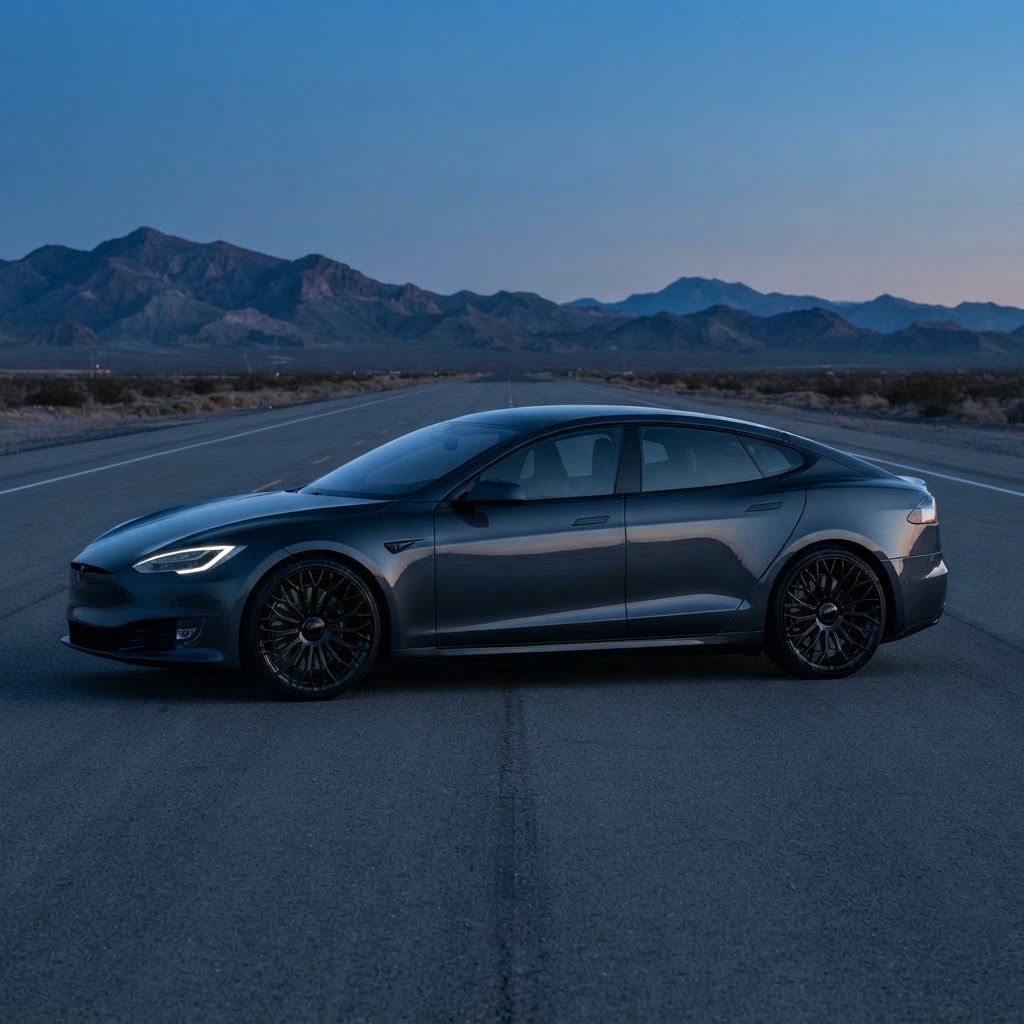
1. Aerodynamics, which dominates at highway speed. At 70 mph, most of your energy goes into pushing air. An open-spoke wheel acts like a fan, churning air inside the wheel well. Tesla's aero covers exist for exactly this reason, and they're worth more than any weight saving. A smooth, closed face or a design with flatter spoke faces costs less drag than an open mesh. This is the single biggest lever, and it has nothing to do with how light the wheel is.
2. Rotating mass, which matters in town and under acceleration. A heavier wheel and tire package takes more energy to spin up, and that energy is lost every time you slow down. A lighter forged set makes the car feel more responsive and helps ride quality, because the suspension has less unsprung mass to control. On a Plaid, with over 1,000 hp, you'll feel the difference in how cleanly the car puts power down, not in your highway range.
3. Tire compound and width. The 21-inch option runs a wider, stickier summer tire with more rolling resistance than the 19-inch all-season setup. That's a real chunk of the range difference, and it's the part people forget when they blame the rims.
So what should you actually do
If range is your priority, the answers are unglamorous and they work:
- Stay at 19 inches if you can live with the look. It's the setup Tesla rated highest.
- Choose a design with more closed spoke faces. Fewer gaps, less turbulence.
- Keep widths close to stock. Extra width buys grip you probably won't use on a commute and costs you drag and rolling resistance.
- Pick the tire for the job. A low-rolling-resistance all-season will beat a max-performance summer tire on range every time, regardless of the wheel.
- Run the pressure on the door placard. On a Model S that's in the mid 40s cold. Under-inflation is a silent range thief and a common one.
What you gain by going forged
Honest answer: a few percent, not ten. A forged set is meaningfully lighter than a cast set of the same size, and that improves ride, steering response and how the car puts power down. It also lets you keep a strong wheel while running a smaller diameter, which is where the bigger range win lives.
What forged construction will not do is cancel out an open-spoke 21-inch design with a sticky tire. Physics doesn't negotiate.
The fitment side
The Model S runs a 5x120 bolt pattern, a 64.1 mm center bore and M14 x 1.5 hardware, torqued higher than most cars. The Plaid's brake package also needs verifying against the spoke profile before you order anything.
If you want a set that keeps the range penalty small, tell us your priorities and we'll steer you toward a design and size that fits the way you use the car. Request a quote.
Tell us your vehicle and we'll engineer the perfect fitment.
Request a Quote