Will Aftermarket Wheels Clear Your Big Brake Kit?
Diameter is only half the story. Spoke clearance is what stops a wheel fitting, and here's how to check it before you order.
Two clearances, not one
People talk about "big brake clearance" as a single number. It's two, and both have to pass before a wheel goes on the car.
Radial clearance is the gap between the inside of the barrel and the outside of the caliper. This is the one diameter influences. An 18-inch wheel has roughly an inch less room than a 19, so a very large rotor and caliper can simply run out of barrel.
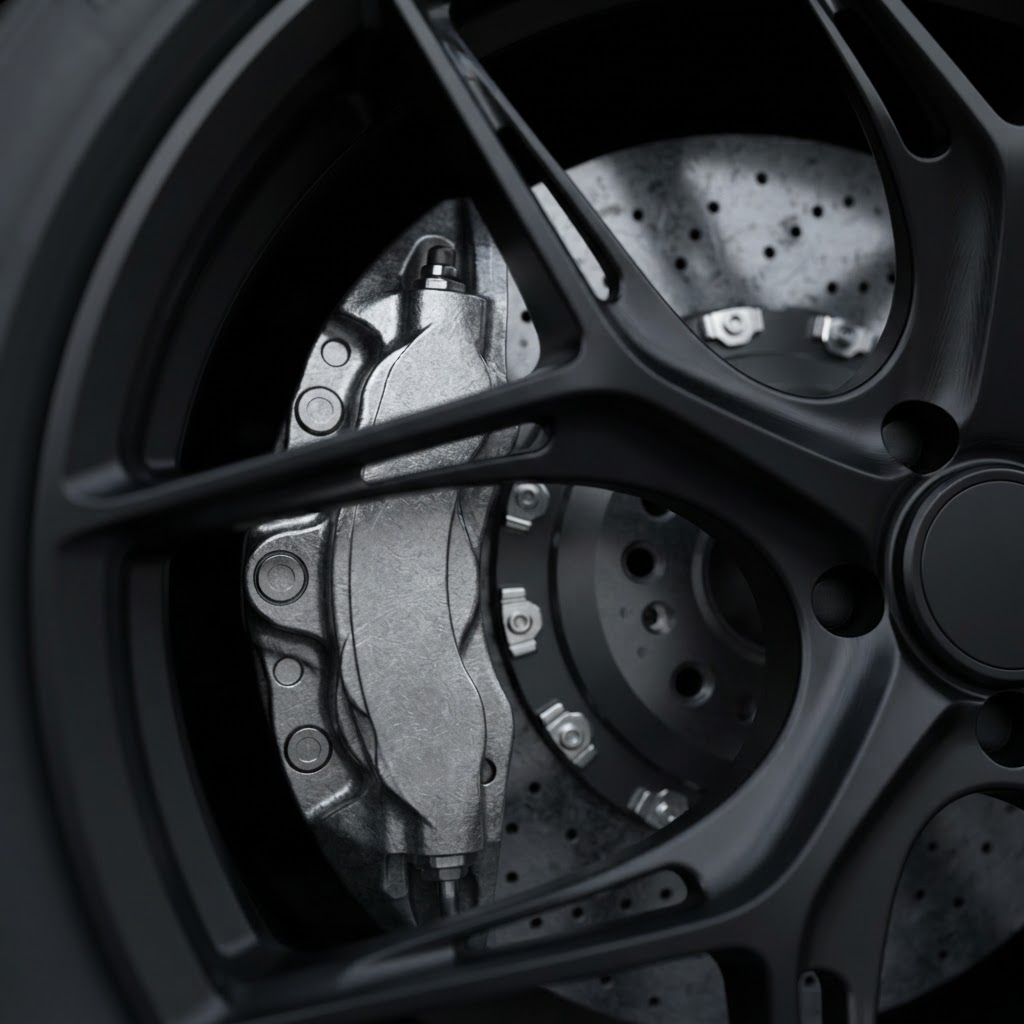
Lateral, or spoke clearance, is the gap between the face of the caliper and the back of the spokes. This is the one almost everyone gets wrong, and it has almost nothing to do with diameter. It's the curve of the spoke as it leaves the hub, plus the offset.
There's a third number suppliers quote: the X-factor, or how far the mounting pad sits below the spoke face. It's a useful summary, but the caliper template is the truth.
Why two 19s can differ completely
Picture two 19x9.5 wheels with identical offsets. One has flat spokes that run almost straight out to the lip. The other has a deep concave face, where the spokes dive inboard as they leave the hub, then sweep back out. The concave wheel loses caliper clearance in exactly the region where a multi-piston caliper sits.
This is the entire reason a wheel that fits a base car can foul the same model with the performance brake package. The diameter didn't change. The spoke did.
How to check before you buy
- Find your brake package. Not the model, the brake package. Base, sport, carbon ceramic, aftermarket big brake kit. They are all different caliper profiles.
- Get a caliper template. Manufacturers of brake kits publish printable profiles at 1:1 scale. Print it, cut it out, and hold it against the inside of the wheel, or against a wheel you've confirmed fits.
- Measure the gap you have now. On your current setup, measure the distance from the caliper face to the spoke, and from the barrel to the caliper. That's your reference for anything new.
- Check the balance weights. A stick-on weight on the barrel can foul a caliper that has a millimetre of clearance. Ask the tire shop to place weights where they clear.
- Consider heat, not just static fit. On track, the caliper grows and radiates. A 2 mm gap that's fine on the street can leave a witness mark after a session.
Spacers: legit, with rules
A slip-on spacer can rescue lateral clearance, and using one isn't a hack when it's done properly:
- Use a hub-centric spacer, so the wheel still locates on the hub.
- Get longer bolts or extended studs with the same seat type and thread pitch.
- Maintain thread engagement: aim for at least the full diameter of the fastener in the hub, and more is better.
- Five-millimetre spacers without a lip are common and fine for small adjustments. Anything thicker needs a lip or a bolt-on design.
What never to do
Don't grind a caliper to make a wheel fit. Don't machine the back of a spoke unless the wheel's manufacturer has told you in writing that it's safe. Brake and wheel components are engineered as systems, and removing material from either changes a load path nobody will recalculate for you.
Our process
When you order a set, we ask for your brake package and cut the spoke profile against the caliper envelope for that car. If the design you like doesn't clear without a spacer, we'll tell you before it's made rather than after it's shipped.
Tell us what you're running and we'll check it. Request a quote.
Tell us your vehicle and we'll engineer the perfect fitment.
Request a Quote