
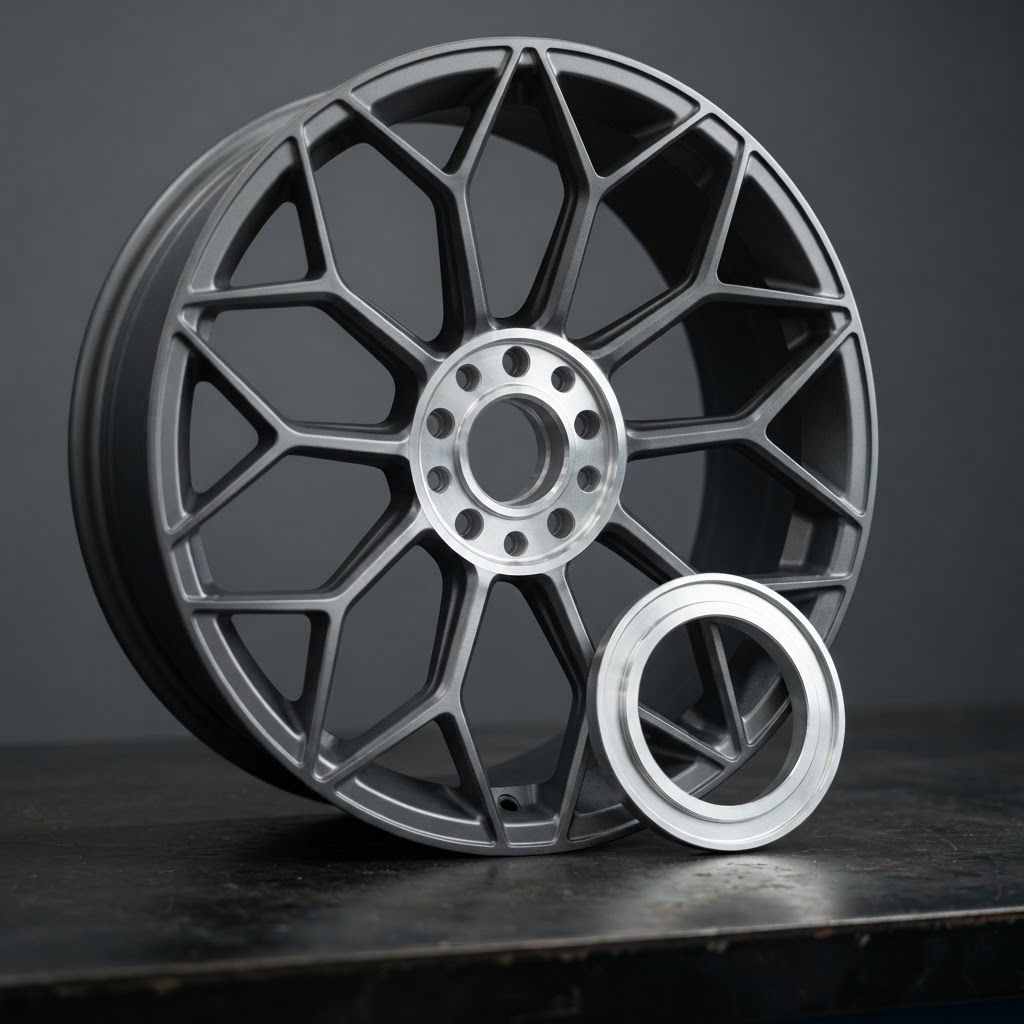
Center Bore and Hub Rings: The Five-Minute Explanation
The hub doesn't carry the car. It locates the wheel, and that's why a $15 ring prevents a vibration you'll spend hundreds trying to diagnose.
Two holes, one job
Every wheel has a hole in the centre of its mounting pad. Every car has a raised lip on its hub. The center bore is the diameter of the hole in the wheel. The hub pilot is the diameter of the lip on the car. When they match, the wheel is hub-centric: it sits on the hub and is perfectly centred before a single lug is tightened.
Common values you'll run into: BMW and Mercedes at 66.6 mm, Audi and Volkswagen at 57.1 mm, Tesla at 64.1 mm, most GM at 66.9 mm, Toyota and Lexus at 60.1 mm, Porsche five-lug at 71.6 mm. If your wheel's bore is bigger than your hub, you need a ring to bridge the gap.
What the hub actually does
Here's the part that gets argued about online, so let's be precise. Once the lugs are torqued, the wheel is held to the hub by clamping force and friction between the two flat faces. The hub pilot is not carrying your car down the road.
What the hub pilot does is locate the wheel. That matters enormously during installation, and it matters more on cars with lug bolts rather than studs. With bolts, you're threading five fasteners into a hub while holding a 25-pound wheel with one hand and hoping it's centred. A few millimetres of slop means the wheel can sit off-centre, and an off-centre wheel at 70 mph feels like a bent rim, a bad balance job, or warped rotors. Owners chase all three before someone checks the bore.
Which ring to use
Rings are sold in plastic and aluminium, and both do the job on a street car. Aluminium is more durable and handles heat better, which matters if the car sees track time. Plastic is fine and cheap, and if it deforms it's usually because something else is wrong.
Rules that actually matter:
- Match both dimensions. Outer diameter to the wheel bore, inner diameter to the hub pilot. A ring that's loose on either side is not doing anything.
- Seat it fully. It should sit flat in the wheel's bore, not perched on the edge.
- Never stack rings to bridge a gap.
- Clean the hub face with a wire brush before the wheel goes on. Corrosion and old balancing weights are the two most common causes of a wheel that won't sit flat.
- Don't use a ring to fix the wrong bolt pattern. It's a centring aid, not an adapter.
The counter-argument, and where it's right
Some people run wheels with a larger bore and no rings and report no vibration. That's real: if the lugs are tightened in a star pattern and the wheel happens to centre itself, everything is fine. It's the times it doesn't that cost you an afternoon. Given that a set of rings costs less than a tank of fuel, there's no sensible reason to skip them.
The better answer
Machine the wheel to the car. Every set we build is cut to your vehicle's exact hub bore, so there's no ring to buy, fit, lose or replace, and no chance of the wheel sitting off-centre. It's also why we ask for your model and year before anything gets made.
Tell us what you drive and we'll confirm the bore. Get a quote.
Tell us your vehicle and we'll engineer the perfect fitment.
Request a Quote