
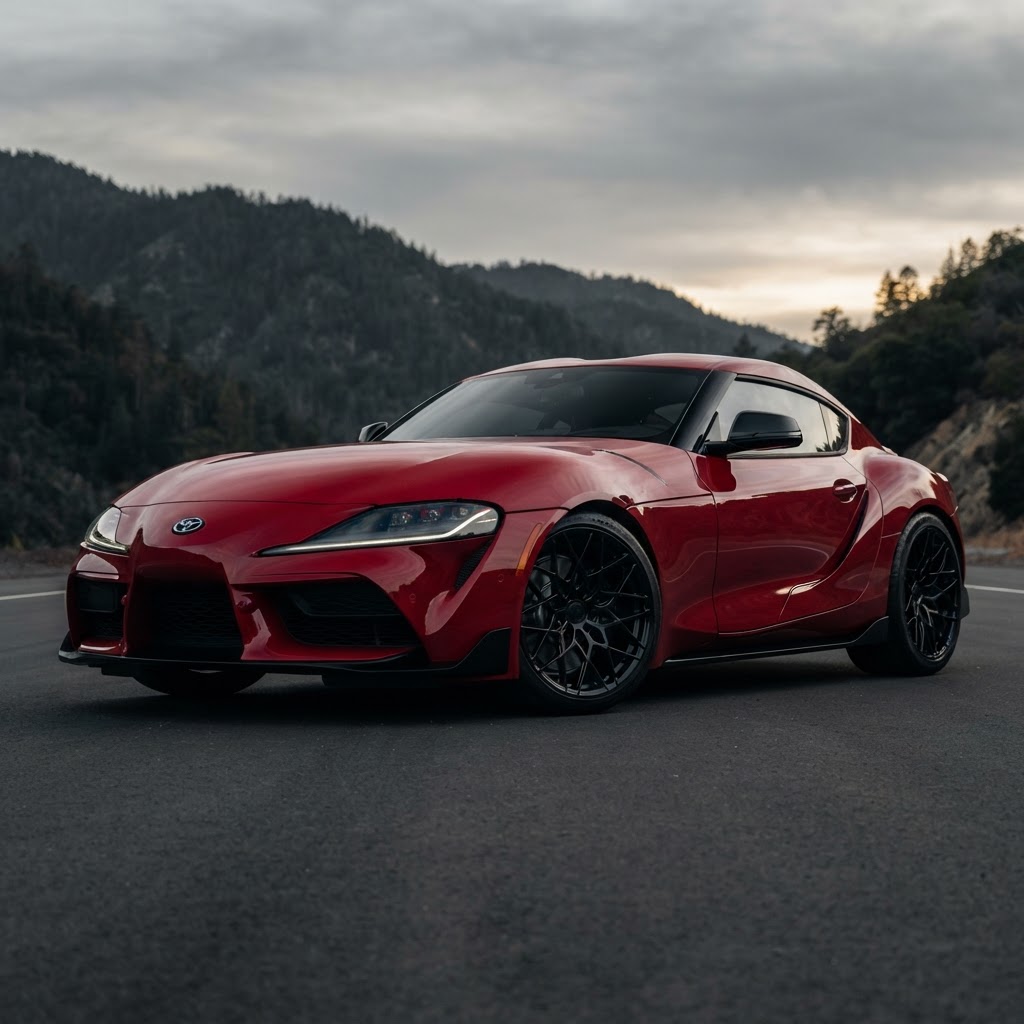
Toyota Supra A90: 18 vs 19 vs 20 Inch Wheels
18 for sidewall, 19 for balance, 20 for the look. Here's what each actually costs on a Supra A90, with sizes that keep your speedometer honest.
The factory starting point
The Supra A90 in 3.0 form ships on 5x112 hubs with a 66.6 mm center bore and M14 x 1.25 lug bolts. From the factory it runs 19x9 front with a +32 offset and 19x10 rear at +40, on 255/35R19 and 275/35R19 tires. The 2.0 car starts on 18s.
That's a good baseline, because it tells you the car was designed around a nine-inch front wheel. Anything much narrower than that is a downgrade in grip, not a style choice.
18 inch
What you get: more sidewall, less wheel mass, cheaper tires in more compounds, and a much better chance of surviving a bad road. On track, the extra sidewall absorbs curb strikes and gives you a bigger usable slip angle. Tire selection is enormous, which matters more than most people admit.
What you give up: looks, mostly, and some brake clearance headroom if you have or plan a big brake kit. An 18 will clear the standard 3.0 brakes, but check before committing if your car has upgraded calipers.
Who it suits: track regulars, anyone driving on rough roads, and people who'd rather spend money on tires than on diameter.
19 inch
What you get: the factory balance. Enough sidewall to be livable, enough wheel to look right in the arches, and the widest possible tire availability in the exact sizes the car wants. If you want one set that does everything, this is it.
Sizing that works: 19x9.5 front and 19x10.5 rear, with 265/35 front and 285/35 rear, or stick with the factory 255/275 widths if you want to keep the steering feel exactly as Toyota tuned it. Front offsets between +30 and +35, rear between +38 and +45. The front is the tight side on this car: the strut and liner leave less room than the rear, so measure before you go wider.
20 inch
What you get: the look. The A90 has big arches and 20s fill them properly.
What it costs: sidewall, weight, money, and ride quality. A 20-inch tire on this car is a short sidewall over a fairly stiff chassis, and potholes stop being theoretical.
Do this if you go 20: keep the rolling diameter close to stock. A 255/30R20 front is within a millimetre of the factory 255/35R19, and a 275/30R20 rear is within a millimetre of the factory 275/35R19. That combination keeps the speedometer honest and keeps you out of trouble if you're lowered. If you go wider than stock, add a little negative camber and check the front liner at full lock.
A note on width and wheel hop
The A90 has a healthy amount of turbocharged torque and a rear end that will hop if you're careless with tires. Wider rear wheels help only when the tire behind them is a proper performance compound. A 10.5-inch rear with a cheap hard tire grips worse than the factory 10-inch with something decent. Buy the tire first, then the wheel that supports it.
What we'd run
For a street car that sees the occasional track day: 19x9.5 and 19x10.5 forged monoblock, satin bronze or gunmetal, on 265/35 and 285/35. Light enough to feel, strong enough to trust, and it keeps the car in the size range it was engineered for.
Tell us your trim and whether you're lowered, and we'll confirm the offsets. Start a quote.
Tell us your vehicle and we'll engineer the perfect fitment.
Request a Quote