
Lug Torque on Aftermarket Wheels: What to Use and What to Avoid
The torque figure belongs to your car, the seat type belongs to the wheel, and getting either wrong is how wheels come loose.
The spec comes from the car
The torque figure belongs to the vehicle, not the wheel. Whoever built your car specified a clamping load for that hub, that stud or bolt, and that thread pitch. Changing the wheel changes the material at the mounting pad, not the fastener. So use the manufacturer's number for your car.
As a rough map: most performance cars on M12 hardware sit around 100 to 120 Nm, and cars on M14 hardware land between 120 and 150 Nm. BMW's M14 x 1.25 spec is 140 Nm, Audi and VW's M14 x 1.5 is 120 Nm, most GM performance models are 140 Nm, and Tesla's M14 x 1.5 spec is 175 Nm. Verify yours in the owner's manual before you pick up a wrench. Guessing is how people end up with stretched studs.
The seat type is not optional
This is the failure people don't see coming. Lug hardware comes in three seat profiles:
- Conical (a 60-degree cone), used on most aftermarket wheels and many Japanese and American cars.
- Ball seat (R12 or R13 radius), which is what BMW and Audi use from the factory.
- Flat seat with a captive washer, common on Toyota and some European fitments.
A ball-seat bolt in a conical wheel contacts on a line instead of a face. It feels tight. It will hold for a while. Then it loosens, because the contact pressure is wrong and the fastener is bending rather than clamping. If your new wheels are cut for a different seat than your factory hardware, you need new hardware with the same thread pitch, seat type and, for bolts, the same shaft length.
How to torque them properly
- Clean the threads and the hub face. No grease, no anti-seize unless the manufacturer specifies it. Lubricant can reduce the friction the torque spec was calculated around by 20 to 30 percent, which means you're overstretching the fastener while the wrench clicks at the right number.
- Seat the wheel on the hub first. Hand-thread every lug before you apply any load. If the wheel has a larger bore and no hub ring, hold it centred while you do this.
- Tighten in a star pattern in stages. Half torque, then the full figure. Never run around the wheel in a circle.
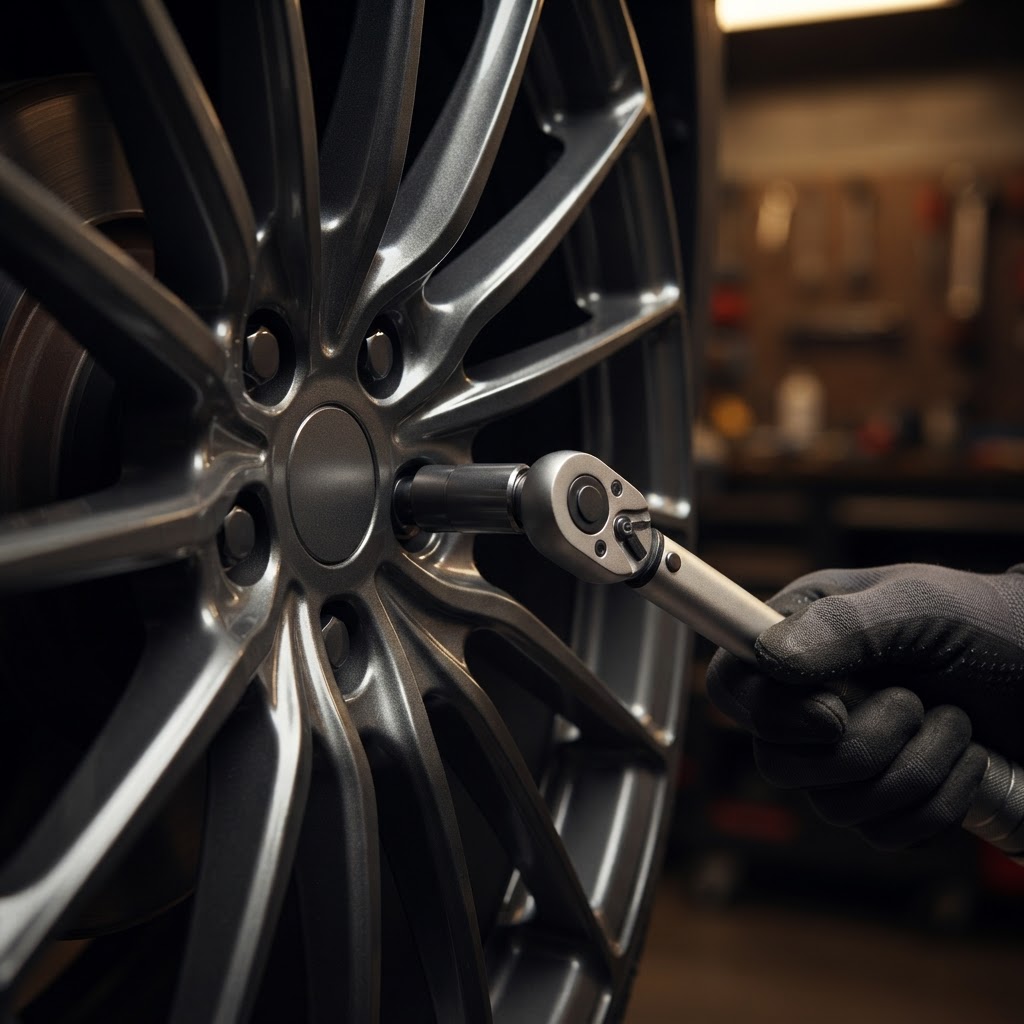
- Use a torque wrench, not an impact gun. Impacts are for removal. A calibrated click-type wrench is cheap compared to a wheel coming off.
- Use a thin-wall socket so you don't mark a fresh finish.
- Re-check after 50 to 100 miles, and again before any track day. Aluminum wheels and their mating surfaces settle, and clamping load drops as they do.
Centerlock is a different world
If you have a centre-lock car, none of the above applies and none of it should be improvised. Centre-lock nuts are torqued to figures in the hundreds of newton metres and require the correct torque multiplier and retaining compound. Follow the factory procedure exactly, and re-check to the factory interval.
One more thing
Torque is not the same as tightness. A wheel properly torqued to 140 Nm and re-checked at 100 miles is safer than one hammered on with an impact until it feels immovable, and it's also the only version that comes off at the side of the road.
Every set we supply ships with hardware matched to the seat type and thread pitch of your vehicle. If you're unsure what yours uses, ask us before you install. Get in touch.
Tell us your vehicle and we'll engineer the perfect fitment.
Request a Quote