
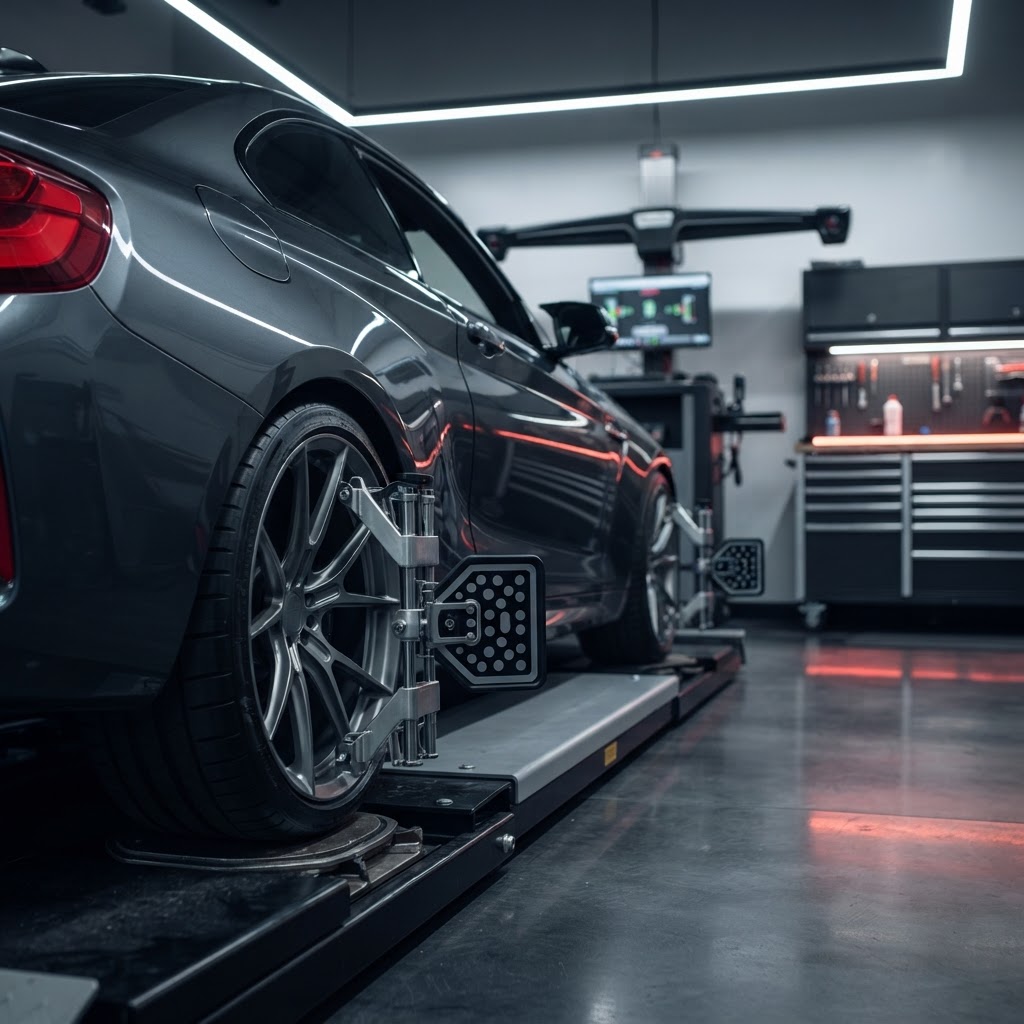
Do You Need an Alignment After New Wheels? An Honest Answer
Strictly speaking, no. Practically, there are four situations where skipping it costs you a set of tires, and one where it costs you a lot more.
The short version
Bolting on new wheels does not change your alignment. Alignment is set by the suspension: tie rods control toe, camber is set at the strut or control arm, caster is baked into the geometry. Wheels are the last item in that chain. Swap them and every alignment angle stays exactly where it was.
So if you mounted a set of wheels on a car with healthy tires wear, correct pressures and a straight-tracking steering wheel, you can drive away. You don't need an alignment because you bought wheels.
That said, "not required" and "not worth checking" are different answers. Here is where a check earns its money.
When you should get one anyway
You changed the suspension at the same time. Springs, coilovers, camber plates, control arms, tie rods, subframe work. Anything that moves a pickup point changes your angles. This is the most common case and the one people skip most often, usually because the car is still apart when the wheels go on.
Your old tires wore unevenly. Inner shoulder wear, cupping, a feathered edge. If those tires came off and new ones went on without an alignment, you paid for a fresh set of tires to be destroyed in the same pattern.
You got hit or clipped something. A curb strike, a pothole hard enough to remember, an accident repair. Bent suspension parts do not always announce themselves with a pull.
The car pulls, wanders, or the steering wheel sits off-centre. Any of these means something is out of spec, and it wasn't the wheels that did it.
What alignment will not fix
This matters, because a lot of people pay for an alignment when the real problem is elsewhere.
- Vibration at 60 to 80 mph is balance, a bent wheel, a flat-spotted tire, or a hub face that wasn't clean. Alignment does not cause vibration.
- A steering wheel that shakes under braking points at rotors, pad deposits, or a hub that isn't seated flat.
- Wandering on grooved highway is tramlining. Wide, stiff sidewalls follow road texture. Toe and tire pressure can soften it, but it is a characteristic, not a fault.
If you do get one, ask for three things
- A before and after printout with camber, caster and toe at each corner. Any shop that won't hand you one is guessing.
- Rim-safe clamps. Alignment heads clamp to the wheel lip. On a fresh set of finished wheels, ask for the shop's protective pads or a tire-clamp system.
- Stock spec, unless you have a reason. For a street car, factory numbers are correct. Track cars can run more negative camber and a touch of toe-out, but that is a deliberate choice with a tire-wear cost.
While you're there, two things that do belong with a new wheel install: clean hub faces with a light wire brush, and a re-torque at 50 to 100 miles. Both take minutes and prevent most of what people blame on alignment.
One more thing on diameter
If your new wheels change the overall tire diameter by more than about 3 percent, your speedometer will read slightly off and gearing shifts with it. That's not an alignment issue, but it is worth knowing before you notice the discrepancy at 70 mph.
Not sure what fits your car? Our fitment advisor will tell you what clears before you spend a dollar.
Tell us your vehicle and we'll engineer the perfect fitment.
Request a Quote