
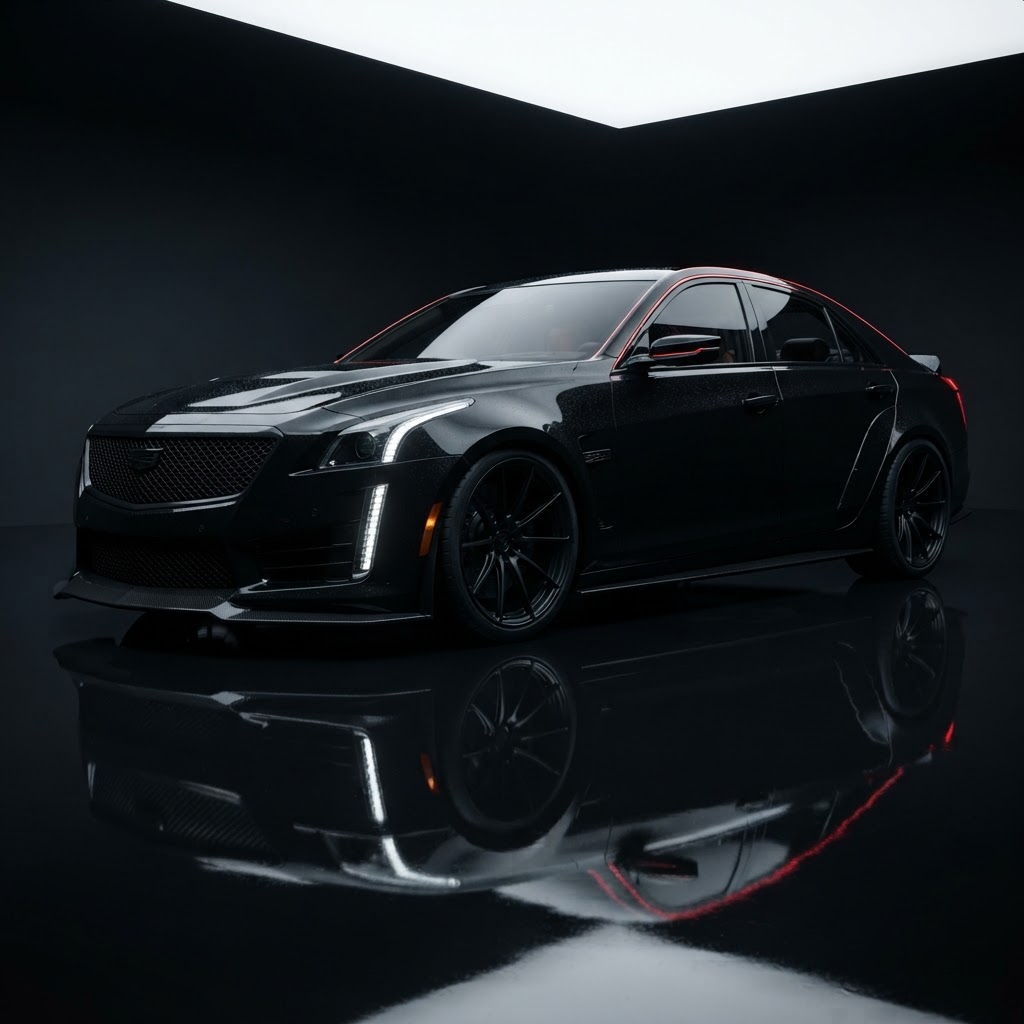
Wheel Fitment for the Cadillac CT5-V Blackwing
A 668 hp rear-drive sedan with big Brembos and 4,100 pounds to carry. Here's what the car actually demands from a wheel, and the sizes that work.
Start with the hard numbers
The CT5-V Blackwing runs a 5x120 bolt pattern, a 66.9 mm center bore, and M14 x 1.5 lug hardware. Get those three wrong and nothing else matters.
From the factory it sits on staggered 19s: 10 inches wide up front on 275/35R19, 11 inches at the rear on 305/30R19. That tells you a lot about how Cadillac engineered the car. There is real rear tire under it for a reason, and that's before you touch the supercharged 6.2.
Three things this car punishes
1. Brake clearance. The front calipers are large six-piston Brembos on rotors close to 400 mm. Diameter alone won't save you. What matters is the spoke profile: the curve of the spoke as it leaves the hub pad has to sweep past the caliper body without touching. Two 19-inch wheels with the same offset can differ by 15 mm of caliper clearance depending on that curve. Send us a caliper template before you buy anything from anyone.
2. Load and stiffness. A Blackwing with a driver is over 4,200 pounds, it makes 659 lb-ft, and it will see track time. A cast wheel that survives on a 3,200 pound coupe is not automatically appropriate here. Forged 6061-T6 gives you the stiffness to keep the contact patch flat under lateral load, and the fatigue margin to survive repeated heat cycles.
3. Rear grip on corner exit. 305 mm is the factory answer. Going wider helps only if the tire you choose is actually available in that size and the wheel width supports it properly.
Setups that work
Track-focused, 19 inch: 19x10.5 front, 19x11.5 rear. Keep the factory 275/35 front tire and move to 315/30 at the rear, which is about 1 percent taller than stock and gives you a wider contact patch without upsetting the speedometer. Light, stiff, and the brakes have room to breathe.
Street-focused, 20 inch: 20x10 front, 20x11.5 rear. Be deliberate with tires here. A 275/30R20 front and 305/30R20 rear ends up roughly 3 percent taller than the factory 19s, which means a small speedometer error and less sidewall over bad roads. Plenty of owners accept that for the look, and it's a fair trade as long as you know you're making it.
Offsets: stay within about 5 mm of factory per axle unless you have measured inner clearance at full lock and at full compression. A Blackwing has a lot of suspension travel and a lot of brake hardware packed into the same space.
Fitment details people forget
The Blackwing uses ball-seat lug hardware from the factory. Many aftermarket wheels are cut for conical seats. Mixing the two is how wheels come loose. Whatever you buy, confirm the seat type and use hardware matched to it.
Also check the TPMS sensors. GM sensors are frequency-specific, and moving them to a new set of wheels is a five-minute job at the tire machine that becomes an hour if you discover it after the wheels are mounted and balanced.
What we'd build
For most Blackwing owners, a forged monoblock in 19 inch, finished in satin black or a machined-face gunmetal, is the right answer. It's lighter than the factory set, it clears the Brembos with room to spare, and it doesn't add another failure point to a car that already asks a lot of its hardware.
Tell us your trim and brake package and we'll spec it around your car. Request a quote or run the visualizer on your own photo first.
Tell us your vehicle and we'll engineer the perfect fitment.
Request a Quote