
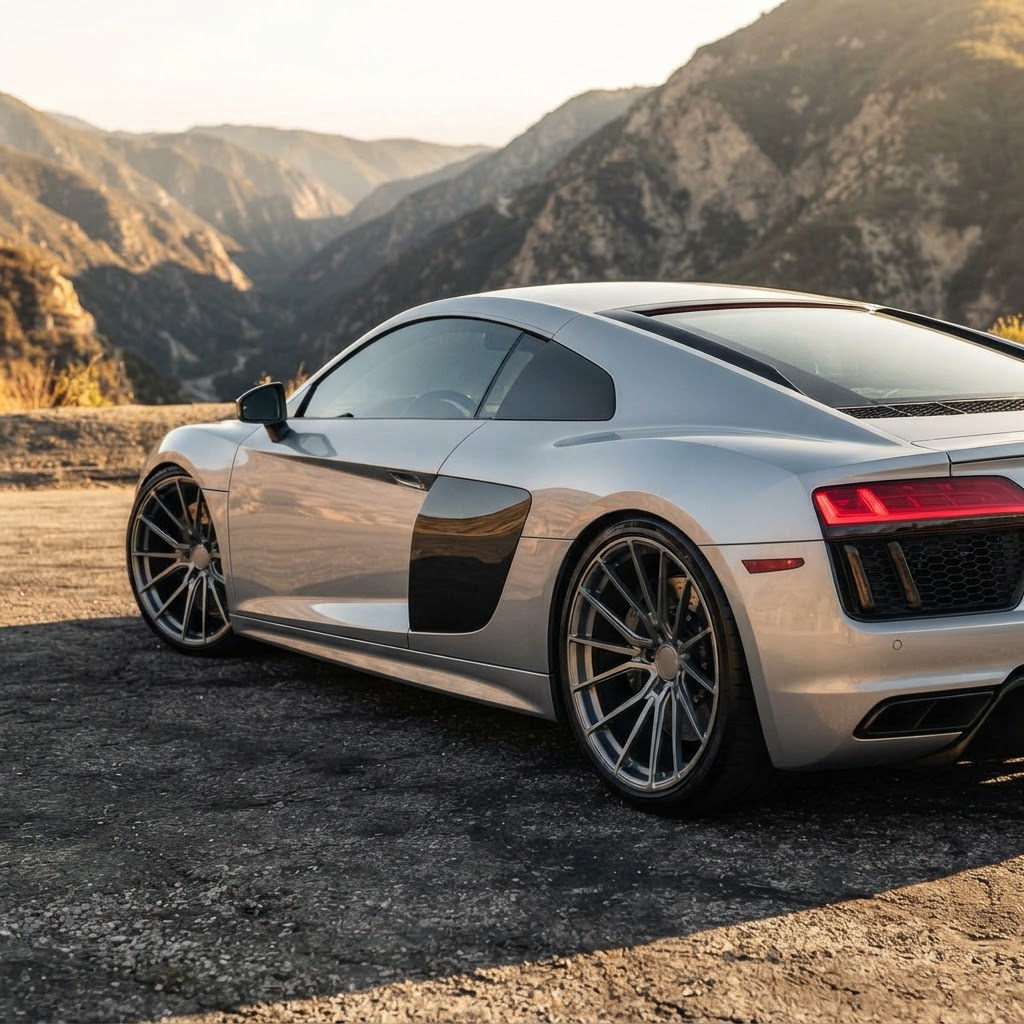
Audi R8 Fitment: Gen 1 and Gen 2 Wheels Are Not Interchangeable
Both generations share a 5x112 bolt pattern and a 57.1 mm bore. That doesn't make the wheels interchangeable, and here's exactly why.
The same bolt pattern, two different cars
Audi kept the R8's hub dimensions remarkably consistent across generations. Both the first generation (Type 42, 2007 to 2015) and the second (Type 4S, 2016 onward) use a 5x112 bolt pattern with a 57.1 mm center bore and M14 x 1.5 ball-seat lug bolts.
That single fact causes a lot of expensive mistakes, because it makes people assume a Gen 1 wheel drops straight onto a Gen 2 car. It usually doesn't.
Where the generations actually diverge
Brakes. This is the big one. Audi went bigger on the Gen 2, and the carbon ceramic option adds calipers that sit further out and further outboard. A 19-inch wheel that cleared a Gen 1 caliper comfortably can foul a Gen 2 caliper by the width of a business card. Diameter tells you almost nothing here. It's the spoke profile and the drop from the hub face that decide it.
Track width and body. The Gen 2 is wider. A wheel that sat flush on a Gen 1 car will sit inside the fender on a Gen 2, and one that sits flush on a Gen 2 will poke on the earlier car.
Wheel diameter from the factory. Gen 1 cars came on 19s: 235/35R19 front, 295/30R19 rear. Gen 2 cars moved to 19s as the base with 20s available on the V10 cars, running a 245/30 front and 305/30 rear on the 20-inch setup.
Why the AWD system makes this stricter
The R8 is permanent all-wheel drive. It compares wheel speeds constantly. If your front and rear rolling diameters differ by more than about 1 percent, you're asking the centre differential and the traction control to work against a mismatch that never goes away. On a car like this, keep the front and rear diameters matched, and match them to what the car expects.
A common mistake is buying a rear pair in a taller sidewall because that's what was in stock. On a front-drive commuter that's an inconvenience. On a mid-engine AWD supercar it's a centre diff you'll be replacing.
Choosing sizes
Gen 1 street setup: 19x8.5 front and 19x11 rear, keeping the factory 235/35 and 295/30. Factory offsets sit in the low 40s up front and around +50 at the rear, and staying near those numbers keeps the scrub radius and the steering feel that Audi engineered into the car.
Gen 2 street setup: 20x9 front and 20x11.5 rear with 245/30R20 and 305/30R20. This is where most owners go, and it fills the arches properly without needing spacers.
Either generation, if you track the car: stay at 19 inches for tire choice and sidewall, and spend the money on forged construction instead of diameter. A mid-engine car with a lot of rear weight bias rewards a light, stiff wheel more than a large one.
The pre-purchase checklist
- Confirm the brake package on your specific car, including whether it left the factory with ceramics.
- Get a caliper clearance template and check the spoke curve, not just the diameter.
- Confirm the ball-seat hardware matches the wheel. Audi uses ball seat; many aftermarket wheels are cut for conical. Wrong seat type equals a loose wheel.
- Match front and rear diameters.
- Check inner clearance to the suspension upright at full lock, on both generations. It's tighter than it looks.
Our approach
We machine every R8 set to the 57.1 mm hub bore and cut the spoke profile against the actual caliper template for your generation. If you tell us which car you have, we'll tell you honestly whether a design works before you commit. Send us your spec.
Tell us your vehicle and we'll engineer the perfect fitment.
Request a Quote